“I was in Berlin on the 13th of last month”
Partners in Crime“I was in Berlin on the 13th of last month” is the second password in the No. 16 protocol, a sentence whose apparent biographical detail functions as a test of recognition. When Tommy Beresford delivers it to a prospective client, he signals that the couple have been warned—and the visitor immediately understands that his cover has been penetrated.
Role in the No. 16 protocol
The British authorities explain that a suspected agent from Moscow may approach the International Detective Agency under the pretext of offering a case. Since he is not personally acquainted with the real Mr. Theodore Blunt, he may test the agency with passwords. The first exchange turns on the number sixteen; the second is an inquiry about whether Tommy has crossed the Channel, answered with the Berlin sentence. The authorities advise Tommy and Tuppence to reply correctly, sustain the fiction if possible, and remain wary even if the visitor seems deceived.
The phrase therefore serves less as a truthful answer to a travel question than as a recognition signal. Its specificity—the city and the thirteenth day of the previous month—makes it a prescribed response rather than an open-ended conversation. The password’s force depends on both parties knowing the formula and on the person answering it understanding the danger attached to the exchange.
Tommy’s use of the phrase
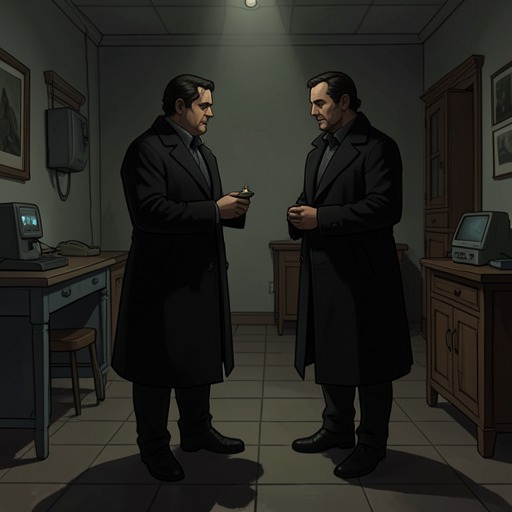
At the agency, Tommy first speaks of the business having run successfully for sixteen years, prompting what he thinks may be a momentary gleam in the stranger’s eye. The visitor then asks whether the agency has branches across the Channel. Tommy answers deliberately that he himself was in Berlin on the thirteenth of the previous month, reproducing the password as instructed.
The controlled delivery lets Tommy answer the test without openly challenging the visitor. Yet the exchange does not preserve the fiction for long. The stranger says that there is little point in continuing it, dismisses the daughter of his supposed friend, and recognizes that the agency has been warned of his coming. He nods toward the calendar on the wall, linking the password encounter to the clues already present in the office.
Exposure and narrative function
The line completes a compact chain of recognition: the authorities disclose the expected question and answer; Tommy repeats the answer at the office; the stranger infers that his arrival was anticipated. What sounds like an ordinary statement of past travel thus becomes an operational act, and its success is measured not by keeping the visitor fooled but by confirming that both sides understand the signal.
The phrase also sharpens the scene’s double play. Tommy follows instructions to gain the agent’s confidence, while the agent proves astute enough to notice the warning and abandon his cover story. The password does not expose the agent’s full identity by itself; instead, it precipitates the visitor’s acknowledgment that he knows what Tommy’s response means, turning a guarded exchange into an explicit recognition of mutual knowledge.